Partner A
Leichter: Do you know the names of your neighbours? Why or why not?
What makes someone a good neighbour?
Anspruchsvoller: How has the concept of a local community changed with the rise of digital communication and remote work?
 Jamesleitet die Live-Runden
Simmonds · live auf simmonds.onlineB15 Min · Englisch
Live-Runden mit Trainer und kleiner Gruppe. Zum Aufwärmen: Theo fragt, Sie antworten.
Mikrofon erlauben – Theo stellt die erste Frage.
KI-Gesprächspartner, synthetische Stimme · Ihre Stimme wird live von Google Gemini verarbeitet, wir speichern kein Audio und kein Transkript · max. 5 MinMehr zur KIMit Kopfhörern können Sie Theo ins Wort fallen. Ohne Kopfhörer hört das Mikrofon erst zu, wenn Theo ausgesprochen hat.
Frage des Tages
Richtige Antwort: Loud music late at night
Im Intro wird auf Deutsch als mögliches Problem „laute Musik spät am Abend“ genannt.
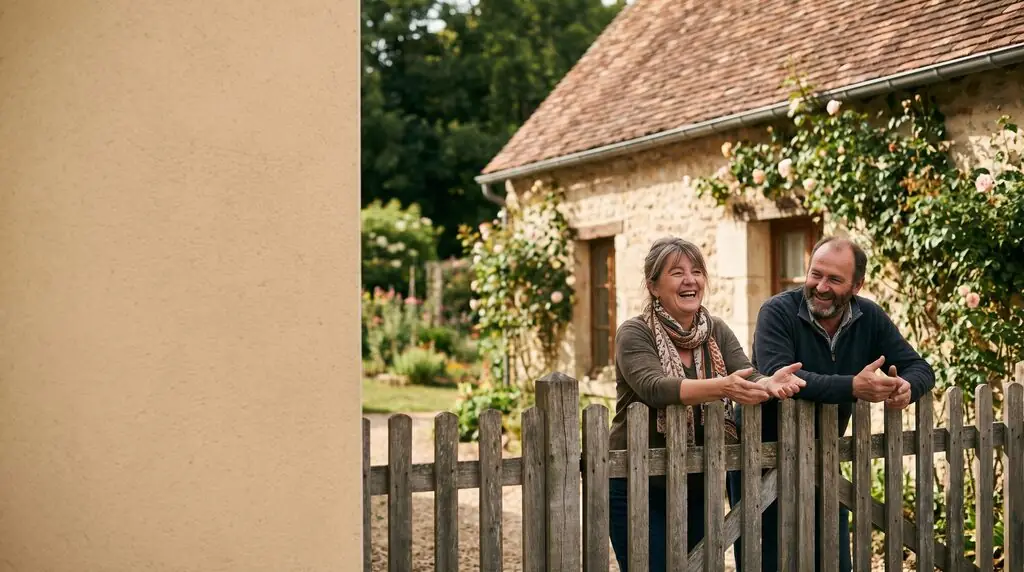
Hi, I'm Theo, and this is a two-minute conversation starter. Today we are talking about the people who live next door – Zum Wortschatz-Eintrag für live next door springen to us. Some people are lucky and get on well with – Zum Wortschatz-Eintrag für get on well with springen their neighbours. They might take in parcels – Zum Wortschatz-Eintrag für take in parcels springen, water the plants when someone is away, or just stop for a friendly chat – Zum Wortschatz-Eintrag für friendly chat springen over the fence. But living close to others can also cause problems. You might have to deal with loud music – Zum Wortschatz-Eintrag für loud music springen late at night, arguments about parking spaces, or a dog that barks all day. A bad neighbour can really ruin your peace and quiet – Zum Wortschatz-Eintrag für peace and quiet springen. How well do you know the people in your street or building? Do you think you are a good neighbour to them?
Partner A
Leichter: Do you know the names of your neighbours? Why or why not?
Anspruchsvoller: How has the concept of a local community changed with the rise of digital communication and remote work?
Partner B
Leichter: Do you prefer to live in a quiet street? Why or why not?
Anspruchsvoller: If you were designing a new residential area, how would you balance private spaces with shared community areas?
Partner A
Leichter: Have you ever helped a neighbour? Why or why not?
Anspruchsvoller: How would you settle a disagreement about noise while protecting a friendly relationship with your neighbour?
| Deutsch | Englisch |
|---|---|
| Wir verstehen uns sehr gut mit unseren Nachbarn. | We get on very well with our neighbours. |
| Könnten Sie morgen ein Paket für mich annehmen? | Could you take in a parcel for me tomorrow? |
| Es tut mir leid wegen des Lärms gestern Abend. | I am sorry for the noise last night. |
| Lass uns am Zaun ein bisschen plaudern. | Let's have a chat over the fence. |
| Wir teilen uns eine Einfahrt mit den Leuten von nebenan. | We share a driveway with the people next door. |
| Es ist wichtig, die Privatsphäre der anderen zu respektieren. | It is important to respect each other's privacy. |
Fünf kurze Fragen prüfen Wortschatz und Hörverstehen.

Schwelgen Sie in der Vergangenheit. Sprechen Sie über Ihre Jugend – mit Mini-Podcast zum Einstieg.
Mit Theo üben →
Ein Notgroschen oder der nächste Urlaub? Sprechen Sie über Geld – mit Mini-Podcast zum Start.
Mit Theo üben →
Stau oder entspannte Zugfahrt? Sprechen Sie über Ihren täglichen Weg zur Arbeit.
Mit Theo üben →Theo ist ein KI-Gesprächspartner zum Aufwärmen, kein Lehrer. Die Stimme ist synthetisch. In den Live-Runden spricht ein Trainer mit Ihnen.
Wir speichern weder Audio noch Transkript. Ihre Stimme wird während des Gesprächs zur Verarbeitung an Google (Gemini) übertragen. Das Gespräch endet nach spätestens fünf Minuten.
Einmal pro Woche: alle Gespräche der Woche, dazu Podcast-Folgen und Termine der Live-Runden. Jederzeit abbestellbar.