Partner A
Easier: Do you know the names of your neighbours? Why or why not?
What makes someone a good neighbour?
More challenging: How has the concept of a local community changed with the rise of digital communication and remote work?
 Jamesleads the live rounds
Simmonds · live on simmonds.onlineB15 min · English
Live rounds with a trainer and a small group. To warm up: Theo asks, you answer.
Allow the microphone – Theo asks the first question.
AI conversation partner, synthetic voice · your voice is processed live by Google Gemini, we store no audio and no transcript · max. 5 minAbout the AIWith headphones you can interrupt Theo. Without them, the microphone only listens once Theo has finished.
Question of the day
Correct answer: Loud music late at night
You can find the answer in the English introduction.
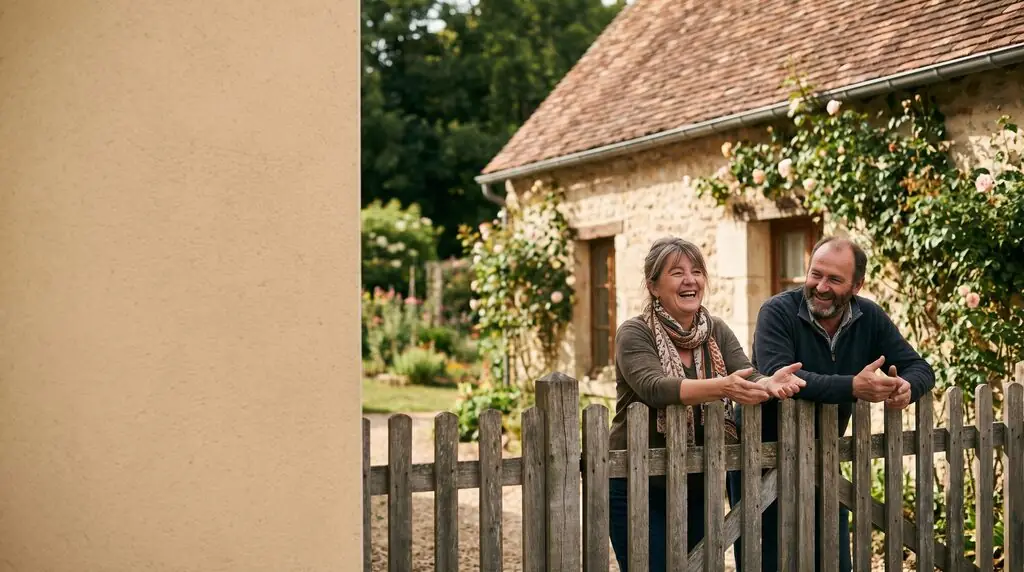
Hi, I'm Theo, and this is a two-minute conversation starter. Today we are talking about the people who live next door – Jump to the vocabulary entry for live next door to us. Some people are lucky and get on well with – Jump to the vocabulary entry for get on well with their neighbours. They might take in parcels – Jump to the vocabulary entry for take in parcels, water the plants when someone is away, or just stop for a friendly chat – Jump to the vocabulary entry for friendly chat over the fence. But living close to others can also cause problems. You might have to deal with loud music – Jump to the vocabulary entry for loud music late at night, arguments about parking spaces, or a dog that barks all day. A bad neighbour can really ruin your peace and quiet – Jump to the vocabulary entry for peace and quiet. How well do you know the people in your street or building? Do you think you are a good neighbour to them?
Partner A
Easier: Do you know the names of your neighbours? Why or why not?
More challenging: How has the concept of a local community changed with the rise of digital communication and remote work?
Partner B
Easier: Do you prefer to live in a quiet street? Why or why not?
More challenging: If you were designing a new residential area, how would you balance private spaces with shared community areas?
Partner A
Easier: Have you ever helped a neighbour? Why or why not?
More challenging: How would you settle a disagreement about noise while protecting a friendly relationship with your neighbour?
Five quick questions check vocabulary and listening comprehension.

Take a trip down memory lane. Talk about your youth, with a mini-podcast to start.
Practise with Theo →
An emergency fund or the next holiday? Talk about money, with a mini-podcast to start.
Practise with Theo →
Traffic jam or a relaxing train ride? Talk about your daily commute.
Practise with Theo →Theo is an AI conversation partner for warming up, not a teacher. The voice is synthetic. In the live rounds, a trainer talks with you.
We store neither audio nor a transcript. During the conversation, your voice is sent to Google (Gemini) for processing. The conversation ends after no more than five minutes.
Once a week: all conversations of the week, plus podcast episodes and live-round dates. Unsubscribe any time.