Partner A
Easier: Do you enjoy your daily commute? Why or why not?
What do you do on your way to work?
More challenging: How might the rise of remote work permanently change the way cities plan their public transport systems?
 Jamesleads the live rounds
Simmonds · live on simmonds.onlineB15 min · English
Live rounds with a trainer and a small group. To warm up: Theo asks, you answer.
Allow the microphone – Theo asks the first question.
AI conversation partner, synthetic voice · your voice is processed live by Google Gemini, we store no audio and no transcript · max. 5 minAbout the AIWith headphones you can interrupt Theo. Without them, the microphone only listens once Theo has finished.
Question of the day
Correct answer: Listen to a podcast
You can find the answer in the English introduction.
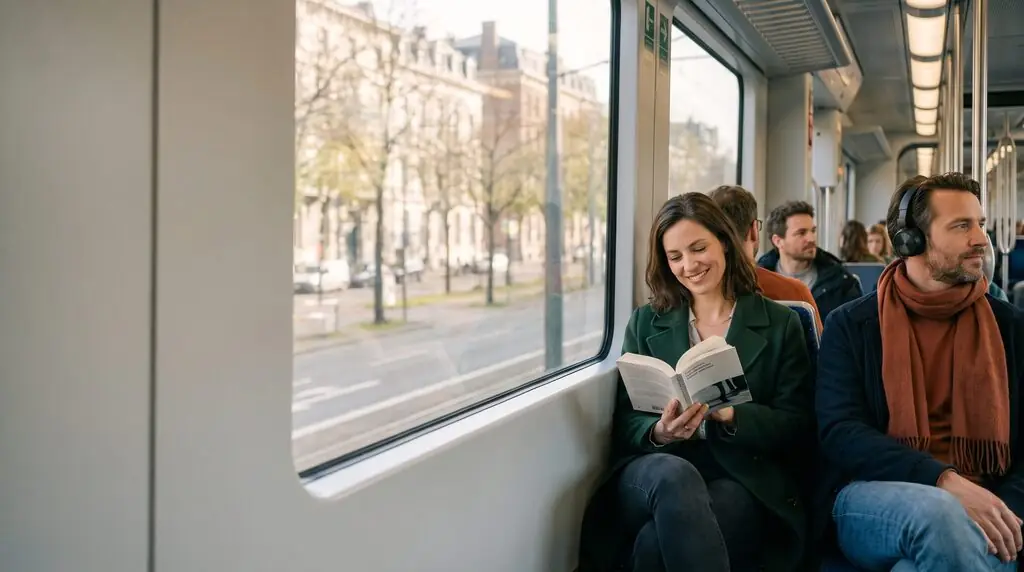
Hi, I'm Theo, and this is a two-minute conversation starter. Today: commuting. For many people, the journey to work – Jump to the vocabulary entry for journey to work is a daily challenge. If you drive, you often sit in a traffic jam – Jump to the vocabulary entry for traffic jam during the morning rush hour – Jump to the vocabulary entry for rush hour. That can feel like a real waste of time – Jump to the vocabulary entry for waste of time. Others prefer to use public transport – Jump to the vocabulary entry for public transport. When you catch the train – Jump to the vocabulary entry for catch the train, you do not have to watch the road. Instead, you can read a book, answer emails, or listen to a podcast – Jump to the vocabulary entry for listen to a podcast. Some people say their commute is the only quiet moment they get all day. It helps them prepare for work. How do you usually travel?
Partner A
Easier: Do you enjoy your daily commute? Why or why not?
More challenging: How might the rise of remote work permanently change the way cities plan their public transport systems?
Partner B
Easier: Is it better to live close to the office? Why or why not?
More challenging: What incentives could employers offer to encourage staff to commute in a more environmentally friendly way?
Partner A
Easier: Do you ever listen to music on the train? Why or why not?
More challenging: If you were a city planner, how would you solve the problem of traffic congestion during peak hours?
Five quick questions check vocabulary and listening comprehension.

Always online? Talk about screen time, with a mini-podcast to start.
Practise with Theo →
Coffee or tea? Talk about your favourite everyday hot drinks.
Practise with Theo →
What is your home like? Talk about your home, with a short text to start.
Practise with Theo →Theo is an AI conversation partner for warming up, not a teacher. The voice is synthetic. In the live rounds, a trainer talks with you.
We store neither audio nor a transcript. During the conversation, your voice is sent to Google (Gemini) for processing. The conversation ends after no more than five minutes.
Once a week: all conversations of the week, plus podcast episodes and live-round dates. Unsubscribe any time.